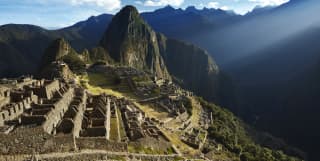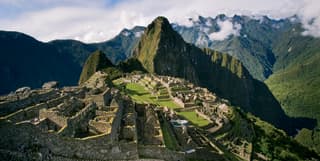

Machu Picchu, the Lost City of the Incas, is one of the most famous examples of Inca architecture and is located 112 km from the city of Cuzco (a 3½ hour train journey), 2,350 meters above sea level.
The ruins are located in a lush jungle and are believed to have been built in the mid-15th century by Inca Pachacutec. Lost in history, the ruins were not discovered until 1911 by the American explorer, Hiram Bingham. This famous citadel combines the visual and spiritual force of magnificent natural scenery with the natural diversity of a historic sanctuary, recognised as a Cultural and Natural Patrimony of the World. Only the Inca and his noblemen, priests, priestesses and chosen women (Akllas) had free access to the premises of the Machu Picchu sanctuary.
The ruins are situated on the eastern slope of Machu Picchu in two separate areas - agricultural and urban. The latter includes the civil sector (dwellings and canalisations) and the sacred sector (temples, mausoleums, squares and royal houses). Although the constructions show different levels of architecture, the religious buildings exhibit a high degree of perfection. The construction was generally in stone and the roofs were built of tree trunks and thatched with ichu or straw. The walls lean slightly inward to protect against earthquakes.
From the peak of the Huayna Picchu, situated opposite Machu Picchu, there is a panoramic view of the imposing spread of ruins and the Urubamba Valley. The breathtaking views from this mountain top citadel and its well-preserved ruins are a photographer's dream. |
|
 |
|
The story of how this famous site was discovered back in 1911 by Hiram Bingham. More » |
 |
|
An introduction to some the myths surrounding this ancient and fascinating site More » |
 |
|
A brief introduction to some of the fascinating native flowers and fauna, that thrives in this remote landscape. More » |
|